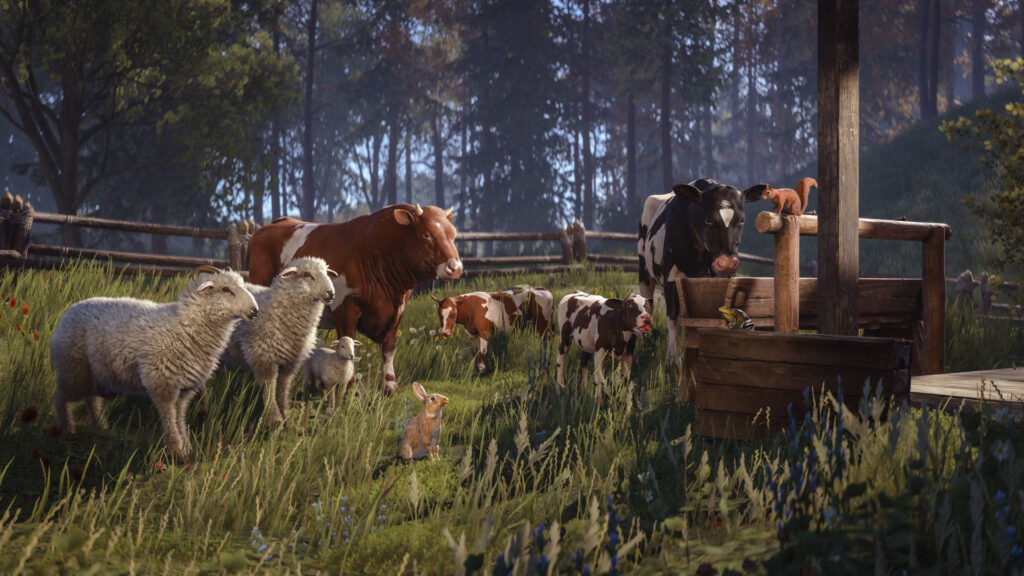
Rust’s October 2026 Livestock Update introduced expanded farming of cows and sheep, with resources such as milk, wool and dung and a breeding system that uses five genetic traits. The letters D, L, Y, F and H have different meanings from the six-slot plant genetics system. This guide explains how to read the traits and plan a livestock farm, while clearly labeling numerical ranges gathered from community references rather than claiming they are direct measurements by Ponch Gaming.
Which animals are part of livestock breeding?

The livestock system covers cows, bulls, calves, sheep and lambs. Mature cows can provide milk and sheep can provide wool, while breeding provides new animals with inherited characteristics. Bulls and some other animals can act defensively.
Animals also produce dung, and slaughtering them may provide meat, bones or hide, though that removes the animal from your herd. Chickens and horses should not be assumed to use the same five-trait breeding interface.
D: Dung production
The D gene influences dung output. The original article’s community figures suggest roughly 4, 6 and 10 units per hour for weak, average and strong states in ordinary conditions.
These numbers are approximate external reference values and may vary by server settings or updates. Do not present them as independently measured guarantees.
L: Lifespan
The L trait is associated with how long an animal lives. Community guide examples in the Arabic source describe approximately 32, 48 and 72 hours across lower, intermediate and stronger grades.
Actual timing can change, especially on modified servers. Check the animal’s own status and the current balance rules.
Y: Milk or wool yield
The Y gene affects resources obtained from livestock. Community guide examples describe milk and wool quantities that vary across weak, average and strong Y grades.
A highly productive animal can be more valuable alive than as a one-time source of meat or materials. Plan herd size and feed consumption rather than optimizing only one resource.
F: Fertility and breeding
F relates to the speed and effectiveness of reproduction, with better states contributing to faster breeding and possibly improved chances of multiple offspring in supported cases.
If your goal is to expand the herd, fertility can matter more than immediate yield. Select breeding pairs with the long-term productivity of the group in mind.
H: Hardiness and care requirements
H indicates how well an animal handles its needs or less favorable conditions. The original guide cites approximate differences in maintenance thresholds from community sources, but does not claim those are universal verified constants.
Keep animals adequately fed and cared for regardless of a strong trait; genetic advantages are not a substitute for basic husbandry.
How to read the trait colors
Traits may be displayed in green for stronger quality, gray for average and red for a weaker value. These colors are a convenient quick reference, but their meanings depend on the specific gene and desired breeding outcome.
A high D cow might suit dung farming, while a strong Y animal may suit milk production. There is no universal five-green combination that solves every resource objective.
Avoid inbreeding and poor selection
Keep track of your breeding lines where possible, avoid careless pairings between closely related animals if the game’s rules penalize them, and retain healthy adults for future breeding.
A sustainable livestock operation needs shelter, materials and care routines. Do not invest everything in one animal with appealing trait colors.
Plants and animals are not the same system
Plant genetics use G, Y, H, W and X across six slots with crossbreeding influence weights. Livestock uses D, L, Y, F and H to describe animal characteristics. Mixing formulas from the two systems produces misleading results.
Related guide: For plant breeding rather than cow or sheep traits, read our Rust Plant Genetics Guide and its linked calculator. Livestock and plants use different sets of genetics, so do not apply plant gene formulas to animals.
Frequently asked questions
Which trait improves dung production?
D, according to the livestock genetic system.
What helps a farm focused on milk or wool?
Y is the key yield trait, though herd care and reproduction also matter.
Are the numeric trait ranges guaranteed?
No. The article labels them as external community estimates that may vary.
Original Rust livestock footage from our creator
For players who want to see more than source tables, Ponch Gaming creator Zack Ponch published firsthand Rust videos featuring the livestock update and farm-based gameplay. The videos are narrated in Arabic:
- Cows and sheep have arrived in Rust — what can you do with them? — original short video, September 14, 2026
- The Cursed Farm (Rust gameplay movie) — original longer farm-based gameplay, October 8, 2026
Evidence distinction: these are genuine creator gameplay videos about farming; the exact D/L/Y/F/H gene mechanics and breeding guidance above come from the linked Facepunch and community documentation. We do not claim to have experimentally verified every genetic value from the footage.
Sources
Independent game coverage. Numbers attributed to community databases are estimates, not tests performed by Ponch Gaming. Game content and screenshots remain the property of their original creators.