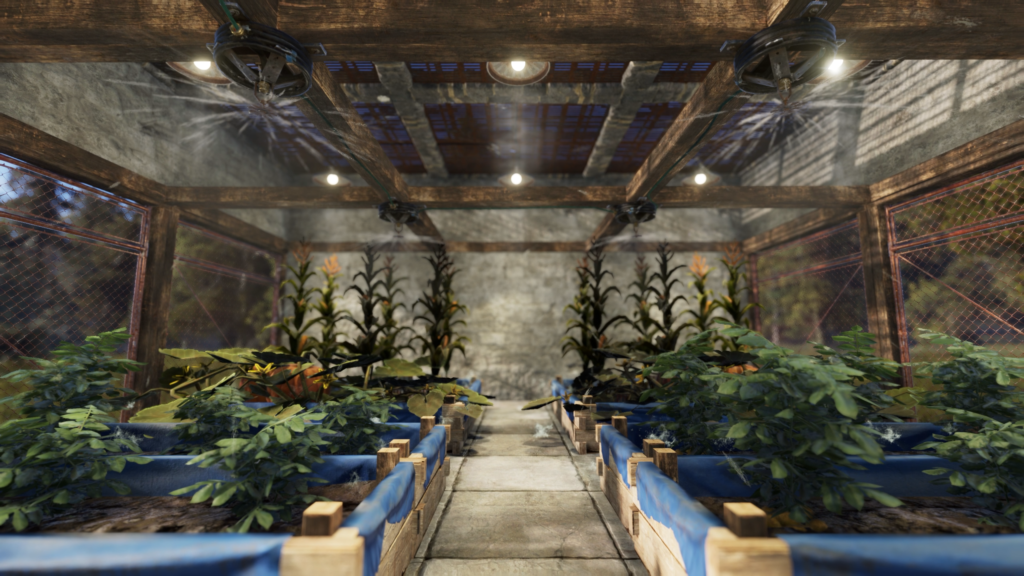
A Rust base can be perfectly secure yet go dark as soon as the sun sets. The problem is often not the number of lights but how the power system is wired. This practical beginner’s guide explains the complete path from a solar panel to a rechargeable battery, switch and ceiling light. It uses the exact English item names found in Rust and checks component ratings against Facepunch’s official wiki rather than repeating untested community recipes.
The four parts of a working Rust circuit
Think of electricity as a chain: generation, storage, control and consumption. A Large Solar Panel produces electricity when sunlight reaches it. A rechargeable battery stores energy for later. A Switch controls whether a circuit is active. A Ceiling Light consumes power and lights the room. If solar panels are wired straight into devices without storage, the system depends on current sunlight and is unsuitable for uninterrupted night lighting.
Rust reports delivered power in rW and battery energy capacity in rWm. These are different quantities. A big stored-energy number is not the same thing as high instantaneous output. When sizing any circuit, consider the load, battery output limit, storage capacity, incoming generation and charging losses independently.
Parts list for your first lighting setup
- Large Solar Panel — Facepunch lists up to 20 rW production; actual output depends on the intensity and angle of sunlight.
- Small Rechargeable Battery — rated at 15 rW output and 400 rWm storage; suitable for a modest first experiment.
- Wire Tool — used to connect the input and output handles of electrical objects.
- Switch — manually turns a line on or off.
- Ceiling Light — draws 2 rW and offers a Passthrough output for passing remaining power onward.
There is no need to rush into complicated smart circuits before you have checked the basics. The item ratings above are a useful starting point, not a promise that a specific setup will last through every night on every server. Lighting conditions, generation time and the load make a difference.
Step-by-step: solar panel to battery to light
- Install the Large Solar Panel in an open location where its exposure can be checked throughout the day. Do not assume that a convenient roof corner receives ideal sunlight.
- Place a Small Rechargeable Battery in a reasonably protected room. It is the backup that keeps a simple light circuit functioning when solar output drops.
- Use the Wire Tool to connect the panel’s Electric Output to the battery’s Power In.
- Connect the battery’s Power Output to the Switch’s Power In.
- Run a wire from Power Out on the Switch to Power In on the Ceiling Light.
- Turn the switch on and check the light, then check the battery’s charging behavior during the day and available charge after sunset.
Large Solar Panel → Small Battery → Switch → Ceiling Light
How many lights can one battery power?
The official Ceiling Light entry lists a consumption of 2 rW. A light can pass the remaining electricity onward through its Passthrough connection. Each additional device uses some of that budget. However, merely dividing the battery’s storage capacity by two does not tell you how many lights can run at once. A small battery has a separately specified 15 rW maximum output, and intermediate components or other loads can reduce the power available.
For your first test, wire a single lamp and watch the battery meter. Add another lamp only after the first works. Then observe a complete day and night cycle. If the battery repeatedly empties, the balance between incoming generation and ongoing consumption is wrong. Adding more battery storage without enough charging power may only delay the failure.
Root Combiner versus Electrical Branch
A Root Combiner has two root-power inputs and one combined output, making it useful when you want to combine power sources such as solar panels before feeding a battery. An Electrical Branch is a different device: it allocates a chosen amount of power to the Branch Out line while routing the remainder through Power Out. Confusing their jobs leads to circuits that are hard to diagnose.
A sensible upgrade path is two solar panels, then a Root Combiner, then a suitably sized battery and carefully measured branch circuits. Remember that the 20 rW listed for a solar panel is a rated value; two panels are not a guarantee of constant 40 rW output in changing sunlight.
Comparing Rust battery sizes
| Battery | Rated output | Listed capacity | Typical beginner use |
|---|---|---|---|
| Small | 15 rW | 400 rWm | Basic lights and tests |
| Medium | 50 rW | 9,000 rWm | Several planned loads |
| Large | 100 rW | 24,000 rWm | More extensive base networks |
These are the listed Facepunch wiki specifications, not guaranteed runtimes. The Medium Rechargeable Battery documentation also describes a maximum charging efficiency of 80%. That is another reason to allow a margin between production and the amount your devices use rather than planning around ideal conditions.
Five common beginner mistakes
- Using solar power alone for night lighting. Put a charged battery between generation and devices.
- Assuming panels always deliver their rated production. Check placement and observe actual output in your location.
- Mixing up ports. Follow the input and output labels instead of drawing wires by appearance alone.
- Leaving essential components exposed. Plan battery and cable placement as part of your overall base security.
- Building too much at once. Diagnose one source, one battery and one load before adding splitters, sensors or more circuits.
What should you build next?
Once you can illuminate a single room consistently, separate lights into useful zones and test the total load before upgrading the battery. A farming room is a natural next application; our Rust plant genetics guide explains the crops you might want to support. If you still need a defensible building, start with our 2×1 starter base guide.
The key lesson: learn the journey from producer to storage to consumer. You do not need to memorize complicated contraptions to avoid the most common electrical failures in Rust.
Frequently asked questions
Will solar panels power my base at night?
Do not rely on the panels for night-time output. Store surplus energy in a rechargeable battery and check whether it has enough charge for your load.
Do I need a Root Combiner for one panel?
No. The simple circuit here uses a direct connection from one panel to one battery. A combiner becomes useful when combining multiple sources.
Why does my light stay off when a battery is installed?
Check the battery’s charge, its Power Output connection, the switch state and whether the connected devices draw more than the available output.
Can I power turrets with this exact setup?
The overall principle applies, but defenses have different power and reliability requirements. Do not copy a small lighting circuit into a turret network without calculating its own load and backup needs.
Official references
- Facepunch: Large Solar Panel
- Facepunch: Small Battery
- Facepunch: Medium Battery
- Facepunch: Large Battery
- Facepunch: Root Combiner
- Facepunch: Electrical Branch
- Facepunch: Ceiling Light
Fact-checked November 6, 2026. Item behavior can change with game patches and server rules.
